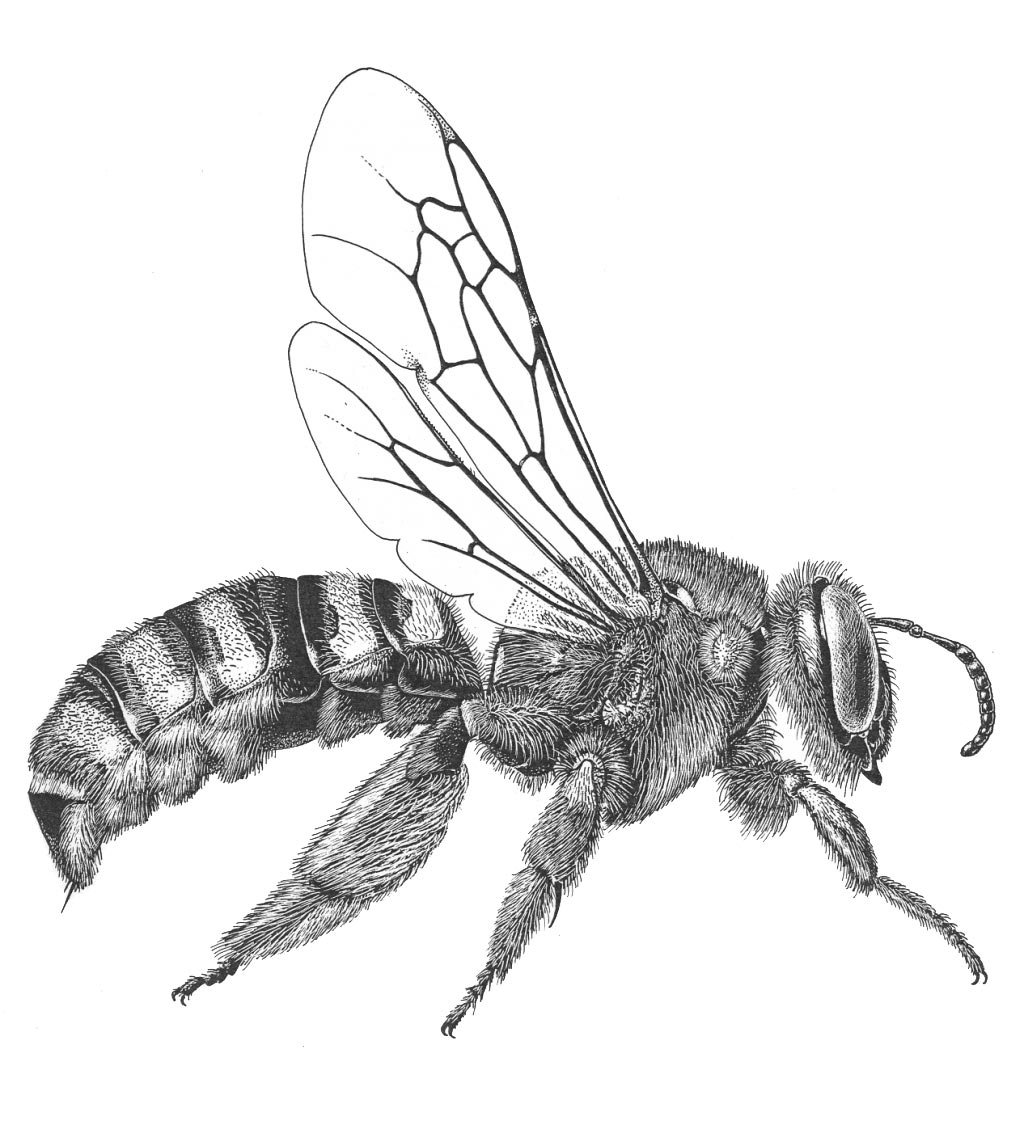
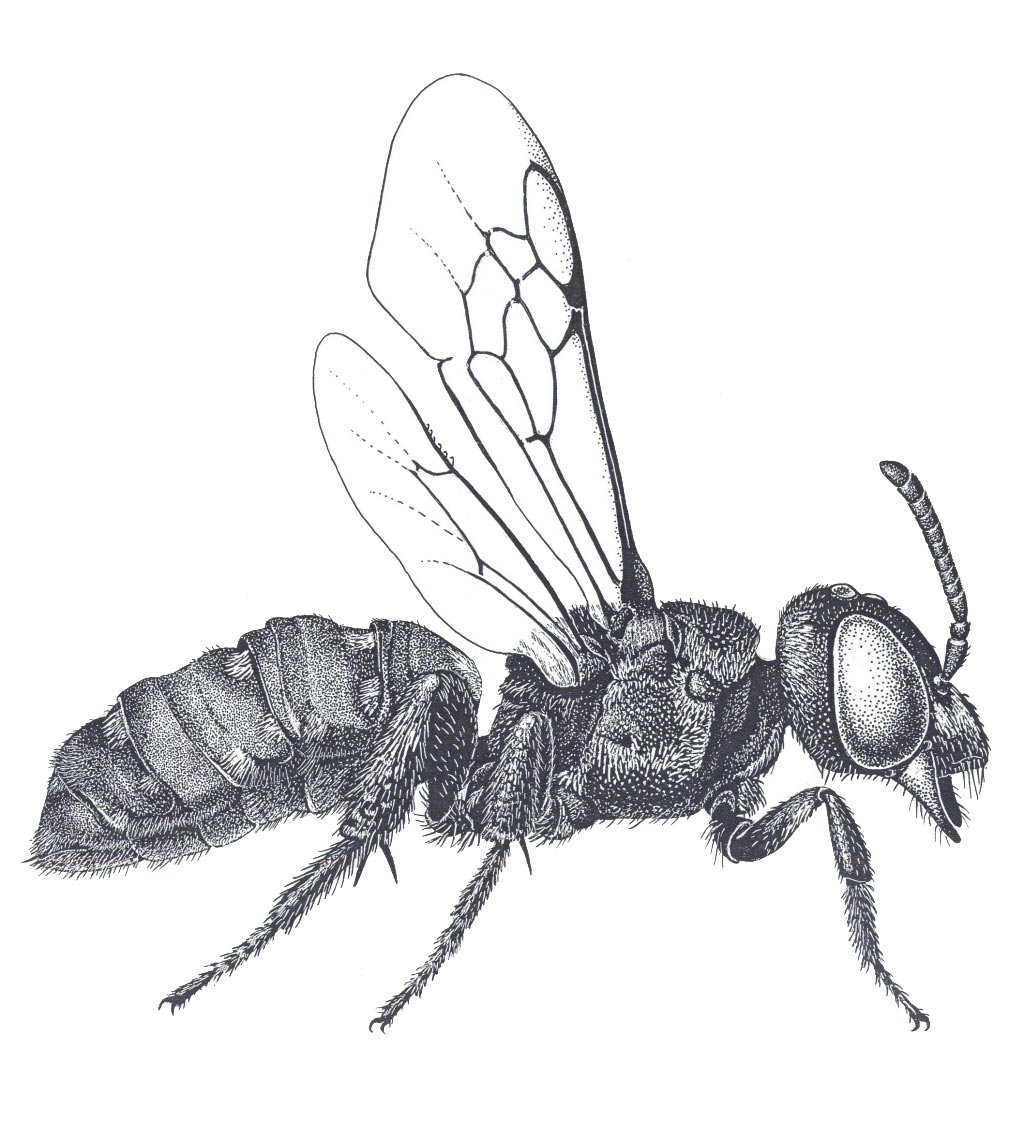
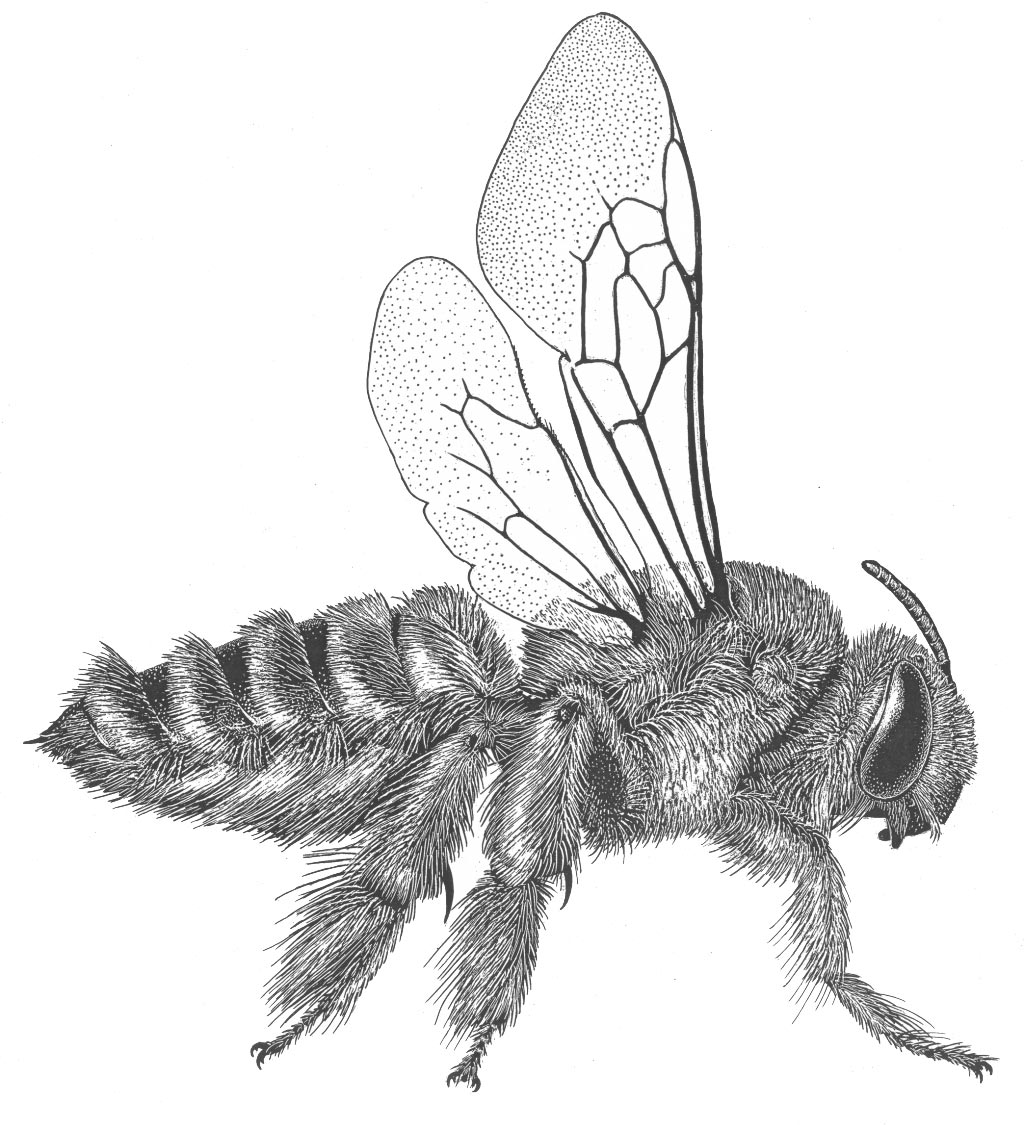
One major focus of the lab is understanding the phylogeny and evolutionary history of bees and related wasps (Aculeata).
We use cutting-edge methods to develop large molecular data sets for resolving phylogenetic relationships among bees at various taxonomic levels. The lab has recently embarked on a new collaborative project on the higher-level phylogeny of bees using a combination of ultra-conserved elements (UCEs) and low-coverage genome (LCG) sequencing. This project involves a collaboration with Elizabeth Murray (Washington State University), Silas Bossert (Washington State University), Michael Branstetter (USDA-ARS Pollinating Insects Research Unit) and Paulmichael Maxfield (Natural History Museum of Utah). The project, entitled “Bees of the World – Phylogenomics, Biogeography, and Evolution of Host-Plant Associations” (DEB-2127744), will allow us to resolve many of the outstanding issues in bee phylogeny, historical biogeography, and host-plant evolution.
Current Projects
The interaction between bees and flowering plants represents one of the most important co-evolutionary stories on earth. The origin of bees (between 110 and 130 my ago) coincides with a rapid increase in angiosperm diversification and the appearance of the largest and most species-rich clade of flowering plants – the eudicots. Flowering plants, with over 350,000 described species, are currently the dominant group of plants in all terrestrial habitats and their dominance is due, at least in part, to their partnership with mobile pollinators – primarily insects and most importantly, bees. Bees provide angiosperm plants with pollination services and plants, in return, provide bees with food for building nests, attracting mates, and rearing offspring. One key to unraveling how the bee-angiosperm partnership evolved over time is to reconstruct both the temporal and spatial patterns of bee diversification. We propose to develop a densely sampled phylogeny of bees at the generic, subgeneric, and species level to examine both historical biogeography as well as patterns of host-plant associations through time.

Previous studies of bee phylogeny have been limited in taxon sampling, geographic sampling, and the number of phylogenetic markers used. The most thorough prior analysis of global bee phylogeny included just 6% of species, 67% of genera, and only a handful of nuclear genes. In order to reconstruct a robust phylogeny of bees, which includes over 20,000 described species, we need more exhaustive taxon sampling across a broader geographic scale, with tools that leverage the power of modern, high throughput phylogenomics.
Our project has three core aims:
Aim 1) Phylogeny — Assemble a comprehensive phylogenomic dataset for bees at the generic level using a combination of low coverage genomes (LCGs) and ultraconserved elements (UCEs).
Aim 2) Historical biogeography — Using the bee phylogeny obtained in Aim 1), compile information on bee fossils and geography to (a) infer a time-calibrated phylogeny for bees and (b) reconstruct historical biogeographic patterns, including vicariance and dispersal.
Aim 3) Host-plant evolution — Using the dated bee phylogeny from Aim 1), analyze patterns of hostplant use in bees in order to (a) reconstruct how host-plant specialization and generalization have evolved over time, (b) test for congruence between bee and angiosperm phylogeny in host-plant specialist lineages of bees, and (c) assess how changes in host-plant breadth have impacted rates of diversification in bees.
Past Projects
For the past 30 years, the Danforth lab has had a focus on understanding higher-level relationships in bees. Using nuclear and mitochondrial DNA sequence data, we helped establish the family, subfamily, tribal, and generic relationships in bees and contributed to studies of bee antiquity, biogeography, host-parasite relationships, bee-plant relationships, social evolution, and classification.
Publications arising from our work (n=45):
- Almeida EAB, Bossert S, Danforth BN, Porto DS, Freitas FV, et al. 2023. The evolutionary history of bees in time and space. Current biology. 33(16):3409–22
- Almeida EAB, Danforth BN. 2009. Phylogeny of colletid bees (Hymenoptera: Colletidae) inferred from four nuclear genes. Molecular Phylogenetics and Evolution. 50(2):290–309
- Almeida EAB, Packer L, Danforth BN. 2008. Phylogeny of the Xeromelissinae (Hymenoptera: Colletidae) based upon morphology and molecules. Apidologie. 39(1):75–85
- Almeida EA, Packer L, Melo GA, Danforth BN, Cardinal SC, et al. 2019. The diversification of neopasiphaeine bees during the Cenozoic (Hymenoptera: Colletidae). Zoologica Scripta. 48(2):226–42
- Almeida EAB, Pie MR, Brady SG, Danforth BN. 2011. Biogeography and diversification of colletid bees (Hymenoptera: Colletidae): emerging patterns from the southern end of the world. Journal of Biogeography. 39(3):526–44
- Bossert S, Murray EA, Almeida EAB, Brady SG, Blaimer BB, et al. 2018. Combining transcriptomes and ultraconserved elements to illuminate the phylogeny of Apidae. Molecular Phylogenetics and Evolution. 130:121–31
- Bossert S, Murray EA, Blaimer BB, Danforth BN. 2017. The impact of GC bias on phylogenetic accuracy using targeted enrichment phylogenomic data. Molecular Phylogenetics and Evolution. 111:149–57
- Bossert S, Copeland RS, Sless TJ, Branstetter MG, Gillung JP, et al. 2020. Phylogenomic and morphological reevaluation of the bee tribes Biastini, Neolarrini, and Townsendiellini (Hymenoptera: Apidae) with description of three new species of Schwarzia. Insect Systematics and Diversity. 4(6):1–29
- Bossert S, Danforth BN. 2018. On the universality of target-enrichment baits for phylogenomic research. Methods in Ecology and Evolution. 9(6):1453–60
- Cardinal S, Danforth BN. 2011. The antiquity and evolutionary history of social behavior in bees. PLoS One. 6:e21086
- Cardinal S, Danforth BN. 2013. Bees diversified in the age of eudicots. Proceedings of the Royal Society B: Biological Sciences. 280(1755):20122686
- Cardinal S, Straka J, Danforth BN. 2010. Comprehensive phylogeny of apid bees reveals the evolutionary origins and antiquity of cleptoparasitism. Proceedings of the National Academy of Sciences. 107(37):16207–11
- Brady SG, Litman JR, Danforth BN. 2011. Rooting phylogenies using gene duplications: An empirical example from the bees (Apoidea). Molecular Phylogenetics and Evolution. 60(3):295–304
- Brady SG, Danforth BN. 2004. Recent intron gain in elongation factor-1α of colletid bees (Hymenoptera: Colletidae). Molecular biology and evolution. 21(4):691–96
- Brady SG, Sipes S, Pearson A, Danforth BN. 2006. Recent and simultaneous origins of eusociality in halictid bees. Proceedings of the Royal Society B: Biological Sciences. 273(1594):1643–49
- Branstetter MG, Danforth BN, Pitts JP, Faircloth BC, Ward PS, et al. 2017. Phylogenomic insights into the evolution of stinging wasps and the origins of ants and bees. Current Biology. 27(7):1019–25
- Danforth BN, Cardinal S, Praz C, Almeida EA, Michez D. 2013. The impact of molecular data on our understanding of bee phylogeny and evolution. Annual Review of Entomology. 58:57–78
- Danforth BN. 1999. Phylogeny of the bee genus Lasioglossum (Hymenoptera: Halictidae) based on mitochondrial COI sequence data. Systematic Entomology. 24(4):377–93
- Danforth BN, Brady S, Sipes S, Pearson A. 2004. Single-copy nuclear genes recover Cretaceous-age divergences in bees. Systematic Biology. 53(2):309–26
- Danforth BN, Cardinal S, Praz C, Almeida EA, Michez D. 2013. The impact of molecular data on our understanding of bee phylogeny and evolution. Annual Review of Entomology. 58:57–78
- Danforth BN, Conway L, Ji S. 2003. Phylogeny of eusocial Lasioglossum reveals multiple losses of eusociality within a primitively eusocial clade of bees (Hymenoptera: Halictidae). Systematic Biology. 52(1):23–36
- Danforth BN, Eardley C, Packer L, Walker KL, Pauly A, Randrianambinintsoa FJ. 2008. Phylogeny of Halictidae with an emphasis on endemic African Halictinae. Apidologie. 39(1):86–101
- Danforth BN, Lin C-P, Fang J. 2005. How do insect nuclear ribosomal genes compare to protein-coding genes in phylogenetic utility and nucleotide substitution patterns?: Phylogenetic utility of ribosomal and protein-coding genes. Systematic Entomology. 30(4):549–62
- Danforth BN, Mitchell PL, Packer L. 1998. Mitochondrial DNA differentiation between two cryptic Halictus (Hymenoptera: Halictidae) species. Annals of the Entomological Society of America. 91(4):387–91
- Danforth BN, Sauquet H, Packer L. 1999. Phylogeny of the bee genus Halictus (Hymenoptera: Halictidae) based on parsimony and likelihood analyses of nuclear EF-1α sequence data. Molecular phylogenetics and evolution. 13(3):605–18
- Danforth BN, Sipes S, Fang J, Brady SG. 2006. The history of early bee diversification based on five genes plus morphology. Proceedings of the National Academy of Sciences. 103(41):15118–23
- Debevec AH, Cardinal S, Danforth BN. 2012. Identifying the sister group to the bees: a molecular phylogeny of Aculeata with an emphasis on the superfamily Apoidea. Zoologica Scripta. 41(5):527–35
- Gibbs J, Brady SG, Kanda K, Danforth BN. 2012. Phylogeny of halictine bees supports a shared origin of eusociality for Halictus and Lasioglossum (Apoidea: Anthophila: Halictidae). Molecular Phylogenetics and Evolution. 65(3):926–39
- Gonzalez VH, Griswold T, Praz CJ, Danforth BN. 2012. Phylogeny of the bee family Megachilidae (Hymenoptera: Apoidea) based on adult morphology. Systematic Entomology. 37(2):261–86
- Grab H, Branstetter MG, Amon N, Urban-Mead KR, Park MG, et al. 2019. Agriculturally dominated landscapes reduce bee phylogenetic diversity and pollination services. Science. 363(6424):282–84
- Hedtke SM, Patiny S, Danforth BN. 2013. The bee tree of life: a supermatrix approach to apoid phylogeny and biogeography. BMC Evolutionary Biology. 13:138
- Kahnt B, Montgomery GA, Murray E, Kuhlmann M, Pauw A, et al. 2017. Playing with extremes: origins and evolution of exaggerated female forelegs in South African Rediviva Molecular Phylogenetics and Evolution. 115:95–105
- Lin C-P, Danforth BN. 2004. How do insect nuclear and mitochondrial gene substitution patterns differ? Insights from Bayesian analyses of combined datasets. Molecular Phylogenetics and Evolution. 30(3):686–702
- Litman JR, Danforth BN, Eardley CD, Praz CJ. 2011. Why do leafcutter bees cut leaves? New insights into the early evolution of bees. Proceedings of the Royal Society B: Biological Sciences. 278(1724):3593–3600
- Litman JR, Griswold T, Danforth BN. 2016. Phylogenetic systematics and a revised generic classification of anthidiine bees (Hymenoptera: Megachilidae). Molecular phylogenetics and evolution. 100:183–98
- Litman JR, Praz CJ, Danforth BN, Griswold TL, Cardinal S. 2013. Origins, evolution, and diversification of cleptoparasitic lineages of long-tongued bees. Evolution. 67(10):2982–98
- Michez D, Patiny S, Danforth BN. 2009. Phylogeny of the bee family Melittidae (Hymenoptera: Anthophila) based on combined molecular and morphological data. Systematic Entomology. 34(3):574–97
- Murray EA, Bossert S, Danforth BN. 2018. Pollinivory and the diversification dynamics of bees. Biology Letters. 14(11):20180530
- Patiny S, Michez D, Danforth BN. 2007. Phylogenetic relationships and host-plant evolution within the basal clade of Halictidae (Hymenoptera, Apoidea). Cladistics. 24(3):255–69
- Pauw A, Kahnt B, Kuhlmann M, Michez D, Montgomery GA, et al. 2017. Long-legged bees make adaptive leaps: linking adaptation to coevolution in a plant–pollinator network. Proceedings of the Royal Society of London B: Biological Sciences. 284(1862):20171707
- Praz CJ, Müller A, Danforth BN, Griswold TL, Widmer A, Dorn S. 2008. Phylogeny and biogeography of bees of the tribe Osmiini (Hymenoptera: Megachilidae). Molecular Phylogenetics and Evolution. 49(1):185–97
- Sless TJ, Branstetter MG, Gillung JP, Krichilsky EA, Tobin KB, et al. 2022. Phylogenetic relationships and the evolution of host preferences in the largest clade of brood parasitic bees (Apidae: Nomadinae). Molecular Phylogenetics and Evolution. 166:107326
- Sless TJ, Danforth BN, Searle JB. 2023. Evolutionary origins and patterns of diversification in animal brood parasitism. The American Naturalist. 202(2):107–21
- Sless TJ, Odanaka KA, Alva-Caballero LX, Searle JB, Danforth BN, Rehan SM. 2025. Expanded phylogeny of Nomadinae (Hymenoptera: Apidae) with integration of UCE and DNA barcode sequence data. Insect Systematics and Diversity. 9(3):1
- Sless TJ, Searle JB, Danforth BN. 2022. Genome of the bee Holcopasites calliopsidis—a species showing the common apid trait of brood parasitism. G3. 12(8):jkac160
In collaboration with colleagues in North America, Europe and Africa, we recently analyzed the phylogenetic relationships among the brood parasitic bee tribes Biastini, Neolarrini, and Townsendiellini. These enigmatic brood parasitic groups form a clearly defined monophyletic group that includes the genus Schwarzia – a rare but fascinating genus of brood parasites from Africa. Our phylogeny is based on analysis of 773 loci generated using probes for ultraconserved elements (UCEs). Our phylogeny provides a basis for analysis of historical biogeography, host-parasite associations, and a revised tribal classification. Lastly, our continued efforts to find the rare Schwarzia in Eastern Africa led to the discovery of three new species, which are described in the paper.
Gallery