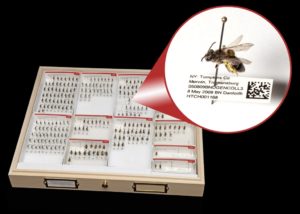
Wild bees are an increasingly important part of the “pollinator portfolio” for modern agriculture. We have ongoing studies on the role of wild bees as apple pollinators in New York state apple orchards.
 Since 2008, when the dramatic losses of honey bee colonies attributed to “Colony Collapse Disorder” occurred, the Danforth lab has been investigating the role of wild bees in crop pollination, with a focus on apple pollination in New York State.
Our work involved an incredibly talented group of post-docs (Laura Russo, EJ Blitzer, Jason Gibbs, Shannon Hedtke, Heather Grab), graduate students (Mia Park, Mary Centrella, Kass Urban-Mead), undergraduates (Rin Krichilsky, Anna Espinoza, Michael Orr), field and laboratory technicians (Maria Van Dyke, Rachel Fordyce), and collaborators (Nacho Bartomeus, Rae Winfree, Scott McArt), to whom we are very grateful.
Funding sources include Smith Lever, Hatch, and Multistate Funds administered by Cornell University Agricultural Experiment Station, USDA-AFRI, NIFA, and SCRI grants, Cornell Atkinson Center Academic Venture Fund, NY Farm Viability, Apple Research and Development Program, and NE Sustainable Agriculture, Research, and Education (SARE) program.
Our work on the role of wild bees as apple pollinators revealed a diverse fauna of over 120 wild bee species visiting flowering apple trees. Based on empirical studies, we showed that wild bees are more effective pollinators (on a per visit basis) than honeybees. Analyses incorporating abundance and per-visit effectiveness indicate that the wild bee community contributes significant value to the production of high-value, tree-fruit in New York. Furthermore, surveys of over 600 apple growers in New York and Pennsylvania revealed an appreciation for the role of wild bees in apple pollination and a willingness to forego honey bee colony rentals. As part of this work, we also developed a pollen reference library for plants in central New York. Overall, our work over the past 20 years has shifted the paradigm of apple pollination in NY, from a honey-bee dependent approach to apple pollination, to one relying much more heavily on the wild, native bees that occur in and around apple orchards in New York and, more broadly, the Northeast. Below we provide a list of the 23 peer-reviewed publications that have arisen from our work.
Publications arising from our work:
- Bartomeus I, Ascher JS, Wagner D, Danforth BN, Colla S, et al. 2011. Climate-associated phenological advances in bee pollinators and bee-pollinated plants. Proceedings of the National Academy of Sciences. 108(51):20645–49
- Bartomeus I, Ascher JS, Gibbs J, Danforth BN, Wagner DL, et al. 2013. Historical changes in northeastern US bee pollinators related to shared ecological traits. Proceedings of the National Academy of Sciences. 110(12):4656–60
- Bartomeus I, Park MG, Gibbs J, Danforth BN, Lakso AN, Winfree R. 2013. Biodiversity ensures plant-pollinator phenological synchrony against climate change. Ecology Letters. 16(11):1331–38
- Blitzer EJ, Gibbs J, Park MG, Danforth BN. 2016. Pollination services for apple are dependent on diverse wild bee communities. Agriculture, Ecosystems & Environment. 221:1–7
- Centrella M, Russo L, Moreno Ramírez N, Eitzer B, Van Dyke M, et al. 2020. Diet diversity and pesticide risk mediate the negative effects of land use change on solitary bee offspring production. Journal of Applied Ecology. 57(6):1031–42
- Eeraerts, M., et al. (2025). Global synthesis of apple pollination research highlights general pollen limitation and positive contributions of wild bees compared to honeybees. Journal of Applied Ecology 62 (10): 2487-2501
- Grab H, Blitzer EJ, Danforth B, Loeb G, Poveda K. 2017. Temporally dependent pollinator competition and facilitation with mass flowering crops affects yield in co-blooming crops. Scientific Reports. 7(1):45296
- Grab H, Branstetter MG, Amon N, Urban-Mead KR, Park MG, et al. 2019. Agriculturally dominated landscapes reduce bee phylogenetic diversity and pollination services. Science. 363(6424):282–84
- Hedtke SM, Blitzer EJ, Montgomery GA, Danforth BN. 2015. Introduction of non-native pollinators can lead to trans-continental movement of bee-associated fungi. PLOS ONE. 10(6):e0130560
- Kennedy CM, Lonsdorf E, Neel MC, Williams NM, Ricketts TH, et al. 2013. A global quantitative synthesis of local and landscape effects on wild bee pollinators in agroecosystems. Ecology Letters. 16(5):584–99
- Kleijn D, Winfree R, Bartomeus I, Carvalheiro LG, Henry M, et al. 2015. Delivery of crop pollination services is an insufficient argument for wild pollinator conservation. Nature Communications. 6(7414):1–6
- Knauer, A., et al. (2025). Pesticides and habitat loss additively reduce wild bees in crop fields. Nature Ecology & Evolution 10: 95-104
- Krichilsky E, Centrella M, Eitzer B, Danforth B, Poveda K, Grab H. 2021. Landscape composition and fungicide exposure influence host–pathogen dynamics in a solitary bee. Environmental Entomology. 50(1):107–16
- Park MG, Joshi NK, Rajotte EG, Biddinger DJ, Losey JE, Danforth BN. 2018. Apple grower pollination practices and perceptions of alternative pollinators in New York and Pennsylvania. Renewable Agriculture and Food Systems. 1–14
- Park MG, Raguso RA, Losey JE, Danforth BN. 2016. Per-visit pollinator performance and regional importance of wild Bombus and Andrena (Melandrena) compared to the managed honey bee in New York apple orchards. Apidologie. 47(2):145–60
- Park MG, Blitzer EJ, Gibbs J, Losey JE, Danforth BN. 2015. Negative effects of pesticides on wild bee communities can be buffered by landscape context. Proceedings of the Royal Society B: Biological Sciences. 282(1809):20150299
- Park MG, Joshi NK, Rajotte EG, Biddinger DJ, Losey JE, Danforth BN. 2018. Apple grower pollination practices and perceptions of alternative pollinators in New York and Pennsylvania. Renewable Agriculture and Food Systems. 1–14
- Russo L, Danforth B. 2017. Pollen preferences among the bee species visiting apple (Malus pumila) in New York. Apidologie. 48(6):806–20
- Russo L, Park MG, Blitzer EJ, Danforth BN. 2017. Flower handling behavior and abundance determine the relative contribution of pollinators to seed set in apple orchards. Agriculture, Ecosystems & Environment. 246:102–8
- Russo L, Park M, Gibbs J, Danforth BN. 2015. The challenge of accurately documenting bee species richness in agroecosystems: bee diversity in eastern apple orchards. Ecology and Evolution. 5(17):3531–40
- Urban-Mead KR, Muñiz P, Gillung J, Espinoza A, Fordyce R, et al. 2021. Bees in the trees: Diverse spring fauna in temperate forest edge canopies. Forest Ecology and Management. 482:118903
- Urban-Mead KR, Walter E, McArt SH, Danforth BN. 2022. Nearly half of spring-flying male Andrena bees consume pollen, but less than female conspecifics. Apidologie. 53(4):49
- Urban‐Mead KR, Van Dyke M, Muñiz P, Young AD, Danforth BN, McArt SH. 2023. Early spring orchard pollinators spill over from resource‐rich adjacent forest patches. Journal of Applied Ecology. 60(3):553–64

In collaboration with colleagues at Rutgers University (Ignasio Bartomeus and Rachael Winfree) and the New York State Agricultural Experiment Station (Alan Lakso), we examined the impact of climate change on the temporal synchrony of bees and apple flowering in central New York over a 46 year timeframe. When the most important apple pollinators were considered together, we found extensive synchrony between bee activity and the peak of apple bloom. Bee species showed different responses to shifting peak apple flowering times, with some species emerging earlier, some later, and some in synchrony with apple over time. However, the number of bee species in synchrony with apple remained stable over the 46 year timeframe of our study, indicating that biodiversity can buffer the impacts of climate change on agriculturally important plant-pollinator interactions. Our study was highlighted in the November, 2013 cover of Ecology Letters (figure above).
Related Files