
Lab News
Research News
Below are some highlights of recent activities in the lab.
Impacts of fungicides on wild bees in apple orchards
http://www.theguardian.com/environment/2015/jun/18/bees-fungicide-flowers-farm-insecticideThe Guardian, 18 June, 2015. Article on Mia Park’s work on apple bees.
New York state establishes pollinator protection plan
http://www.governor.ny.gov/news/governor-cuomo-announces-taskforce-develop-pollinator-protection-plan-protect-new-yorksNew York State Governor Mario Cuomo announces taskforce to develop a Pollinator Protection Plan to protect New York’s agricultural economy.
Undergrad research
http://cornellsun.com/blog/2015/02/10/peer-review-graham-montgomery-15-investigates-bee-genus-history/Cornell Daily Sun, 10 February, 2015. Article on Graham Montgomery’s work on Rediviva bees.
Bryan Danforth was recently awarded the Thomas Say award from the ESA for significant work in the fields of insect systematics, morphology, or evolution.
Climate change and orchid bees
http://www.news.cornell.edu/stories/2014/03/dry-future-climate-could-reduce-orchid-bee-habitatCornell Chronicle, 20 March, 2014. Article on Margarita Lopez-Uribe’s work on orchid bees.
Northeast Pollinator Partnership
http://cornellcals.tumblr.com/post/79277276520/new-project-aims-to-promote-home-grown-appleCALS News, 24 October, 2011. New project aim to promote home-grown apple pollinators.
Pollen or pollinators — which came first?
https://www.danforthlab.entomology.cornell.edu/files/all/beesangiosperms_currbiol2012.pdfReport on Cardinal & Danforth 2013 published in Current Biology.
Impact of CCD on local farmers and beekeepers
http://www.innovationtrail.org/post/farmers-and-beekeepers-respond-colony-collapseWSKG radio report on the impact of CCD on Finger Lakes beekeepers and farmers.
All abuzz…
http://cornellalumnimagazine.com/index.php?option=com_content&task=view&id=1300&Itemid=56&ed=28Cornell Alumni Magazine, 1 March, 2012. Cornell entomologists ponder the pollinators.
Cornell Chronicle, 11 December, 2011. Native bees and climate change.
Jason Gibbs and a new bee species from the Big Apple
http://cityroom.blogs.nytimes.com/2011/11/10/bees/New York Times, 10 November, 2011. City Bees Newly Discovered, Yet Here All Along.
Cornell Chronicle, 24 October, 2011. Native bees and apple pollination. Click here to read the article.
PhD position available in bee biology
https://www.danforthlab.entomology.cornell.edu/phd-position-available-in-bee-biology/PhD position available in bee biology
CALS News, 17 November, 2010. Bee database creates buzz.
Cornell Chronicle, 14 September, 2010. History of ‘cuckoo bees’ needs a rewrite, study reports.
Cornell Daily Sun, 8 September, 2010. The Mysterious Collapse of the American Honeybee.
Cornell Chronicle, 24 July, 2010. New $1.5 million bee database will help track declines, pollination and more.
Sophie Cardinal finishes her PhD!
https://www.danforthlab.entomology.cornell.edu/sophie-cardinal-finishes-her-phd/Congratulations to Sophie!
Margarita Lopez-Uribe passes her A-exam!
https://www.danforthlab.entomology.cornell.edu/margarita-lopez-uribe-passes-her-a-exam/Congratulations to Margarita!
Protecting our diverse native bee fauna
http://www.theithacajournal.com/apps/pbcs.dll/article?AID=2009907250301The Ithaca journal recently published a short editorial on the importance of native bees in agricultural pollination.
Empire State Native Pollinator Survey
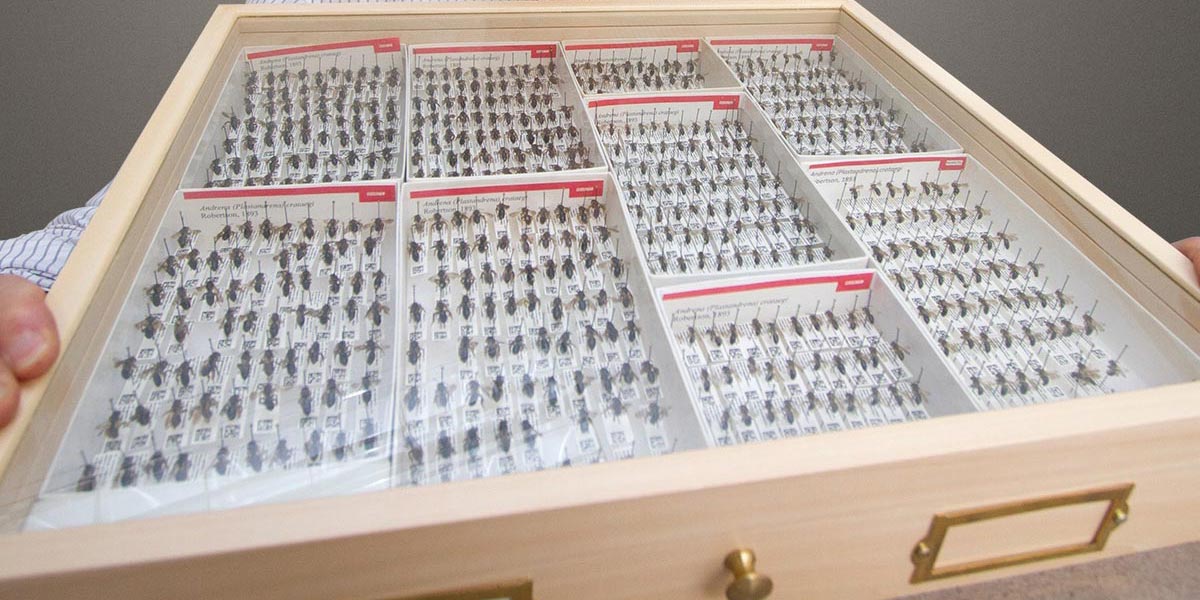
Our lab is involved in a state-wide survey of bees and other pollinators as part of an effort led by the NY Natural Heritage Program to develop an “Empire State Native Pollinator Survey”. The goal of the Empire State Native Pollinator Survey is to determine the conservation status of a wide array of native insect pollinators in nonagricultural habitats, including bees.
The project will involve extensive surveys throughout NY state to help determine the conservation status of the most important pollinators in the state, with a focus on Andrena, Megachile, Melissodes, Macropis, and Bombus. In addition to the extensive surveys we will be conducting targeted habitat surveys, focused on habitats that are rare of threatened and targeted species surveys, focused on specific taxa including oil bees in the genus Macropis and bumble bees. The project will have a significant “citizen science” component.