
Much of the work in our lab focuses on understanding and documenting patterns of bee diversity on a local, regional and global scale.
We conduct research on a wide range of topics related to Bee Diversity. We contribute to the growth and development of the Cornell University Insect Collection through field work on bees in western North America, South and Central America, Australia, Africa (including Madagascar), and Europe. On a more local scale, we have conducted surveys of wild bees in NYS apple orchards, and we recently contributed to a comprehensive statewide survey of New York pollinators (the Empire State Native Pollinator Survey), in partnership with the New York Natural Heritage Program (see below). Most recently we have embarked on a community science effort focused on documenting, studying, and protecting ground nesting bee aggregations (Project GNBee; see below). Our lab has deep appreciation for bee diversity as well as a core commitment to bee conservation.
Current Projects

Project GNBee
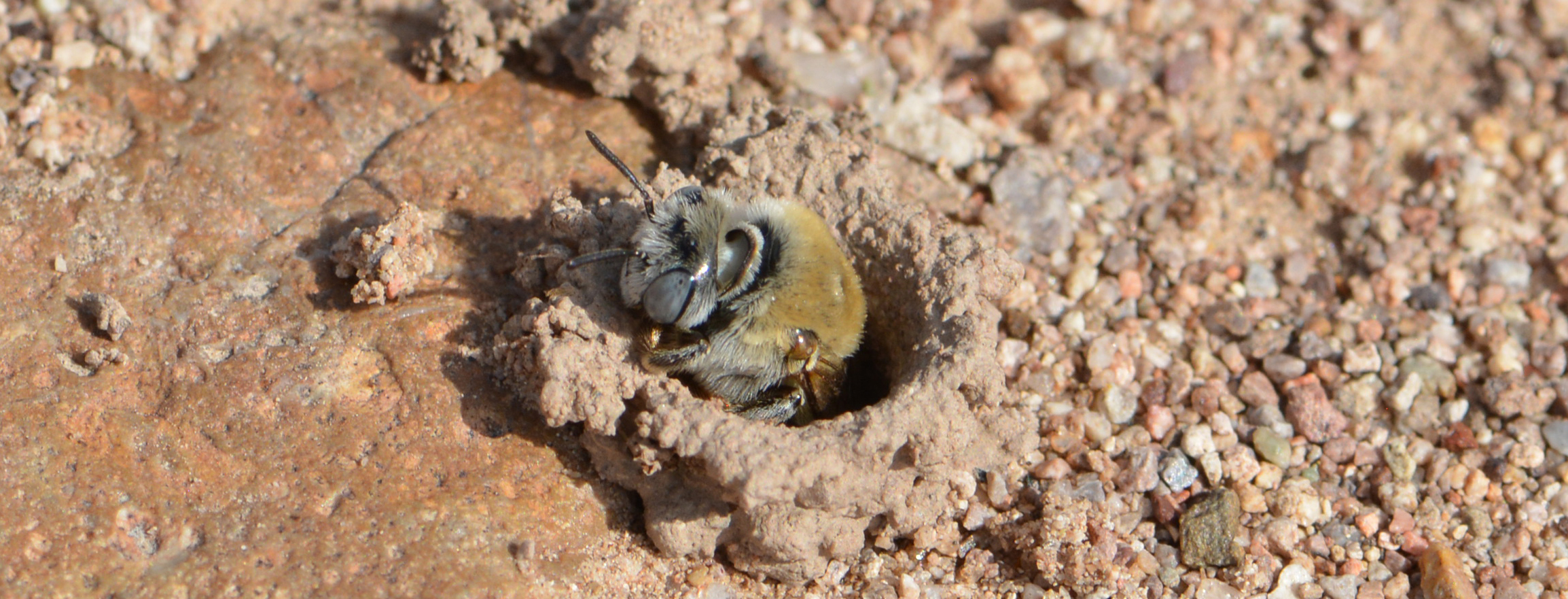
Our lab recently initiated a community science project focused on identifying and mapping aggregations of ground-nesting bees using the iNaturalist platform. “Project GNBee” seeks to utilize the power of community science to identify, and ultimately, conserve aggregations of ground-nesting, solitary bees.
Project goals include: (1) Engaging community scientists to locate and map nesting sites of ground nesting bees, (2) using biotic and abiotic landscape data from existing nest-sites to develop models to predict the locations of additional nestsites, (3) establishing native bees aggregations in agricultural habitats in order to enhance fruit production, especially in high value specialty crops like apples.
Additional information on the project can be found here:
Project GNBee website
iNaturalist project
The project will help us understand how factors like topography and soil characteristics impact the locations of nesting aggregations and may allow us to create suitable nesting habitat in the future. We also hope that the project will lead to conservation efforts focused on protecting sites that host large aggregations of ground-nesting, wild bees.
This project is supported by a grant from the Cornell Atkinson Center for Sustainability.
For more information on Project GNBee, contact Jordan Kueneman.
Empire State Native Pollinator Survey
Our lab is involved in a state-wide survey of bees and other pollinators as part of an effort led by the NY Natural Heritage Program to develop an “Empire State Native Pollinator Survey”. The goal of the Empire State Native Pollinator Survey is to determine the conservation status of a wide array of native insect pollinators in nonagricultural habitats, including bees.
The project will involve extensive surveys throughout NY state to help determine the conservation status of the most important pollinators in the state, with a focus on Andrena, Megachile, Melissodes, Macropis, and Bombus. In addition to the extensive surveys we will be conducting targeted habitat surveys, focused on habitats that are rare of threatened and targeted species surveys, focused on specific taxa including oil bees in the genus Macropis and bumble bees. The project will have a significant “citizen science” component.
Project update from Erin White and Matt Schlesinger (14 May, 2021): video (20 mins)
For more information on the Empire State Native Pollinator Survey, see the project website or contact Maria Van Dyke.

Macropis
The bee family Melittidae is among the most important of all bee families. The family includes just over 170 described species but many species are narrow host-plant specialists and they may represent a very early branch of bee phylogeny.
Macropis nuda (above) is a representative of the subfamily Melittinae. Macropis are oil collecting bees that specialize on a single genus of plants (Lysimachia).
Drawing by Frances Fawcett.